

LEAK DETECTION WEST PALM BEACH
Moisture Mapping & Inspection in West Palm Beach
Thermal imaging and moisture-meter readings pinpoint hidden dampness without opening walls — with a written report and moisture map your insurer or contractor can act on.
✓ Non-invasive thermal imaging & moisture meters ✓ Serving West Palm Beach & Palm Beach County ✓ 24/7 emergency response
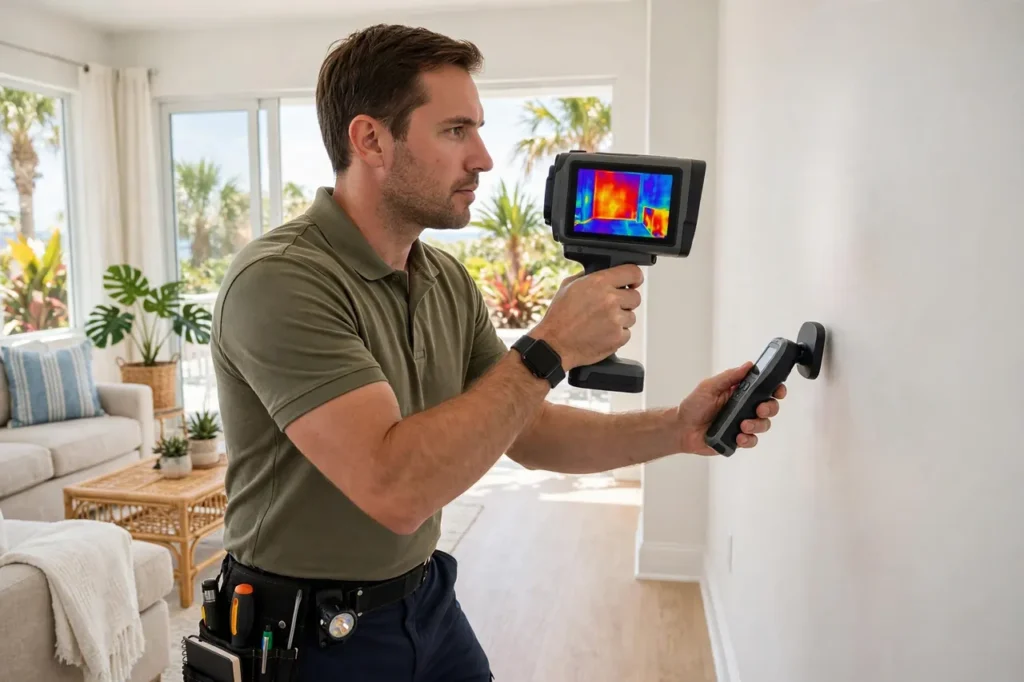
LIVE READOUT — THERMAL IMAGING SWEEP
1–3h
Avg. inspection time
0
Walls opened (typical)
60d
Findings guarantee
Hidden dampness inside walls, ceilings, and floors causes most mold problems and failed insurance claims in South Florida — and you cannot see it. Moisture mapping is a non-invasive inspection that finds trapped water and documents exactly where it is. For West Palm Beach homes, we combine thermal imaging with moisture-meter readings to pinpoint hidden dampness without opening walls, then deliver a written report with a moisture map your insurer or contractor can act on.
Signs Your Home May Need a Moisture Inspection
You do not need standing water to have a moisture problem. Call for a professional moisture inspection when you notice:
- A musty or earthy odor that returns after cleaning
- Humidity that feels higher in one room than the rest of the house
- Staining, bubbling paint, or warping on walls, ceilings, or baseboards
- A history of roof leaks, plumbing repairs, or flooding — even years ago
- White powdery residue (efflorescence) on concrete or stucco
- You are buying a home and want to know what the seller’s disclosure missed
After tropical storms and King Tide flooding, hidden intrusion is common even when everything looks dry on the surface.
How the Inspection Works, Step by Step
- Visual walkthrough. We look for staining, warping, efflorescence, and past repair marks — the visible clues that point to hidden problems.
- Thermal imaging scan. An infrared camera sweeps walls, ceilings, and floors for temperature patterns that suggest dampness behind the surface.
- Moisture-meter readings. Pin and pinless meters take actual readings at every suspect area, then compare them against a dry standard for the material (the industry’s IICRC S500 dry standard). This is what turns a suspicion into a measurement.
- The map. Every reading is plotted on a floor plan, marking wet-versus-dry boundaries room by room. That drawing is the moisture map.
- Written report. Photos, readings with locations, the map, and recommended next steps — formatted so an adjuster or contractor can use it directly.
What Our Equipment Can — and Can’t — Tell You
Honesty about tools is part of the service. Here is what each one actually does:
| Tool | What it tells you | Its limitation |
|---|---|---|
| Thermal imaging camera | Surface temperature patterns that suggest dampness | Does not measure moisture — every finding needs meter confirmation |
| Pinless moisture meter | Relative moisture near the surface, no damage to finishes | Shallow depth; tile, metal, and foil backing mislead it |
| Pin-type moisture meter | Precise moisture percentage at depth | Leaves tiny pinprick holes in the test spot |
| Hygrometer / psychrometer | Indoor humidity and dew-point conditions | Measures the air, not inside your walls |
One example of why this matters: you cannot get an accurate moisture reading through tile floors — a fact some inspectors skip. We tell you where readings are reliable and where they are not, in the report itself.
What Your Moisture Map and Report Include
- Dated photos of every suspect area
- Moisture readings with exact locations
- A floor-plan moisture map showing wet-versus-dry boundaries
- A plain-language summary of findings
- Recommended next steps: drying scope, further testing, or contractor referral
The report is built to be handed to an insurance adjuster, a buyer, or a remediation contractor without translation.
Mapping vs. Mold Testing vs. Leak Detection
These solve different problems. Picking the wrong one wastes money:
| Mapping & inspection | Mold testing | Leak detection | |
|---|---|---|---|
| Question answered | Where is the water? | Is there mold, and what kind? | Where is the leak coming from? |
| Main tools | Thermal camera, moisture meters | Air and surface samples, lab analysis | Acoustic, thermal, pressure testing |
| When you need it | After leaks, before drying, for insurance docs | Visible mold or health concerns | Active leak, high water bill, slab symptoms |
If your problem is hidden moisture detection after a roof leak or plumbing failure, mapping comes first. If you already see mold growth, you need a Florida-licensed mold assessor — state law (Statute 468) licenses assessors separately from remediators, precisely to keep the diagnosis independent.
When a Water Damage Inspection Calls for Mapping
Not every water event needs a full map — but these do:
- After a roof or plumbing leak, to find how far water traveled beyond the visible stain
- After flooding, to check wall cavities and subfloors before you rebuild
- Before restoration or drying, to set a measured baseline (drying without a baseline is guessing)
- After drying, to verify materials actually reached the dry standard — our post-drying verification confirms the job is done, not just looks done
- Before buying, when a general home inspection flags dampness but cannot say how bad it is
West Palm Beach Homes: Where Moisture Hides
Local building stock creates local moisture patterns:
- CBS (concrete block + stucco) homes: water trapped inside block cavities is invisible from the surface — the most common hidden-moisture trap we see.
- Historic El Cid and Flamingo Park homes: wind-driven rain finds old roofs and window seals; plaster-and-lathe holds moisture that drywall would shed.
- Flagler Drive and downtown condos: stack leaks between units, with HOA responsibility disputes that make documentation critical.
- Slab-on-grade homes: moisture wicks under tile and hides there — including from under-slab plumbing issues.
- The climate itself: 80%+ humidity means nothing air-dries naturally; King Tides and Intracoastal surge push saltwater (Category 3) into ground floors; snowbird and vacant homes sit unchecked for months.
For slab-on-grade homes where the moisture source is unclear, foundation leak detection can determine whether you’re dealing with a plumbing leak, groundwater, or drainage issues.
After Storms: Insurance Documentation
Florida gives you one year from the date of loss to give your insurer notice of a claim, and eighteen months for supplemental claims (Fla. Stat. § 627.70132). Miss it and the claim is gone — even if the damage was real. For a water damage inspection tied to an insurance claim, documentation quality decides the outcome: timestamped photos, meter readings, and a moisture map beat “it looked wet” every time. Carriers also draw a hard line between sudden damage (a burst pipe) and gradual damage (a slow seep) — the report distinguishes which one your evidence supports. Our full guide: does homeowners insurance cover leak detection in Florida.
What It Costs in West Palm Beach
Cost depends on property size, how many areas need mapping, and how detailed the report must be (an insurer-ready package takes longer than a quick check). For honest context, published third-party ranges: SporeSure (Palm Beach County) lists $210–$490 across its inspection tiers; industry inspection ranges run roughly $118–$600 depending on scope and market. Those are other companies’ published prices, not ours — standalone detection-only pricing is rarely published locally, which is exactly why we put the cost factors in writing instead of a made-up flat rate. Related reading: what leak detection costs in West Palm Beach.
Frequently asked questions
How long does the inspection take?
Most homes take one to three hours, depending on size and how many areas need readings. The report follows after the visit — we do not rush the map to hit a time slot.
Will it damage my walls?
Thermal imaging and pinless meters are completely non-invasive. Pin-type meters leave tiny pinprick holes only where we test — we tell you beforehand and keep them to suspect areas.
Does homeowners insurance cover the inspection?
It depends on your policy and what caused the moisture. Sudden, accidental water damage is typically covered; gradual seepage usually is not. Either way, the documentation strengthens any claim — see our Florida insurance guide.
Do I need mapping or mold testing?
Different questions. Mapping finds where water is hiding; mold testing identifies whether mold is present and what kind. If you see mold or have health concerns, get a licensed mold assessor. If you suspect hidden water — after a leak, a storm, or near kitchen and bathroom plumbing — mapping comes first.
If you suspect hidden dampness — after a leak, a storm, or a stain you cannot explain — moisture mapping gives you proof instead of guesses: where the water is, how far it spread, and a report you can act on. Call (728) 224-6444 to schedule your inspection.