

WEST PALM BEACH, FL · POOL & SPA LEAK DETECTION
Stop topping off the pool and find the leak.
Pool leak detection in West Palm Beach usually starts the same way: topping off the pool more than once a week, even in a West Palm Beach summer. We pressure and dye test skimmers, drains, and underground lines to find the exact leak before you pay for a guess.
✓ Licensed & insured technicians ✓ Testing without draining the pool ✓ Serving 33401 · 33405 · 33407
CHECK IT YOURSELF FIRST
The bucket test: how to tell if it’s really a leak
Fill a bucket with pool water and set it on the top step so the water level inside matches the pool’s water level. Mark both with tape, run the pool normally for 24 hours, then compare. The EPA WaterSense program notes that unnoticed water loss like this can add up significantly over a year, which is one more reason not to put off testing. Our guide to telling a pool leak from evaporation goes deeper on reading the results.
Pool drops more than the bucket
You’re not losing water to evaporation — you’re losing it to a leak.
Pool and bucket drop evenly
That’s normal evaporation, more so in peak summer heat — up to about a quarter-inch a day.
Gap holds for several days
A consistent gap beyond a quarter-inch a day is worth a real pressure and dye test.
WHERE TO LOOK
Where pool leaks actually hide
- SKIMMERS — The most common leak point on older pools — a skimmer throat that’s separated from the shell, or a return fitting with failed sealant.
- DRAINS — Harder to spot without dye testing, since the leak is often below the waterline and out of sight.
- PLUMBING — Cracked or shifted PVC lines running between the pool and the equipment pad.
- SHELL — Less common, but pools on the same shifting sandy soil that causes slab leaks can develop shell cracks over time, especially older gunite pools.
HOW WE TEST IT
How we test it
01
You tell us what you’re seeing
How fast the water’s dropping, and whether it’s worse with the pump running or off.
02
We pressure test the lines
Isolating a leaking line from a healthy one in minutes rather than hours.
03
We dye test suspect areas
Skimmers, lights, main drains, and any visible crack, to watch exactly where water is pulled through.
04
We show you the result
Before recommending any repair, and give you a real price for fixing what we actually found.
WHAT IT COSTS
What pool leak detection costs
A straightforward skimmer or fitting leak is usually diagnosed and confirmed within an hour or two, on the lower end of our pricing range. A suspected underground plumbing leak or a leak with no obvious source takes more equipment time and is priced accordingly, with the exact number given before any repair work begins.
Skimmer / Fitting Leak
Lower end of range
Diagnosed and confirmed within an hour or two in most cases.
Underground / No Obvious Source
Higher end of range
Pressure testing multiple lines takes more equipment time.
POOL LEAK BASICS
Plumbing Leaks vs. Structural Leaks
Pool leaks generally fall into one of two categories. A plumbing leak happens in the pipes carrying water between the pool and the equipment pad — including the underground lines, skimmer throat, return lines, and main drain plumbing. A structural leak happens in the pool’s shell or surface itself — the gunite, plaster, vinyl liner, or the tile line and surrounding deck. The two require different testing approaches, which is why an accurate diagnosis matters before anyone starts guessing at a fix.
Underground Pool Plumbing
The pipes connecting your pool to the pump, filter, and heater run underground between the shell and the equipment pad. Because they’re buried, a crack or separated fitting in one of these lines can lose a meaningful amount of water without any visible sign at the surface — pressure testing each line individually is typically how it’s found. If the same underground line issue is affecting your yard more broadly, our underground leak detection page covers that in more depth.
Skimmer Leaks
The skimmer is one of the most common leak points, especially on older pools. Over time the skimmer throat can separate slightly from the pool shell, or the sealant around the fitting can fail, letting water seep out behind it. Dye testing right at the skimmer body usually confirms this quickly.
Return-Line Leaks
Return lines carry filtered water back into the pool, and a crack or loose fitting anywhere along that underground run can leak steadily, often only noticeable when the pump is running. Comparing water loss with the pump on versus off is one of the simplest ways to tell whether a return line is involved.
Main Drain Leaks
Main drains sit at the deepest point of the pool, which makes a leak there harder to spot visually since it’s below the waterline and often under water pressure from the pool itself rather than pushing out. Dye testing directly over the drain, combined with pressure testing the drain line, is generally needed to confirm it.
STRUCTURAL AREAS
Pool Shell, Tile Line, and Other Structural Leak Points
Structural leaks are less common than plumbing leaks, but they do happen, particularly on older gunite pools sitting on the same shifting, sandy soil that contributes to slab leaks in homes nearby. Places worth checking include:
- Cracks in the pool shell itself, often hairline at first and easy to miss without dye testing
- The tile line, where the tile meets the shell and grout or sealant can deteriorate over time
- Areas around pool lights, where the conduit and fixture seal can loosen or degrade
- Cracks in the surrounding deck, which sometimes point to a plumbing leak underneath rather than a deck problem on its own
Spa, Fountain, and Equipment-Related Leaks
Attached spas and water features have their own plumbing and structural connections, and often their own separate leak points even when they share a pool’s system. A spa that loses water faster than the attached pool, or a fountain/water-feature line that keeps needing water added, is usually tested the same way as the main pool — pressure testing the dedicated lines and dye testing the shell and fittings. Equipment pad leaks (around the pump, filter, or heater unions) are also worth a visual check first, since those are usually visible rather than hidden.
TESTING, EXPLAINED
A Closer Look at How Pool Leak Testing Works
Beyond the pressure and dye testing already covered above, a couple of related points come up often enough to explain in more detail.
Acoustic and Electronic Detection on Pools
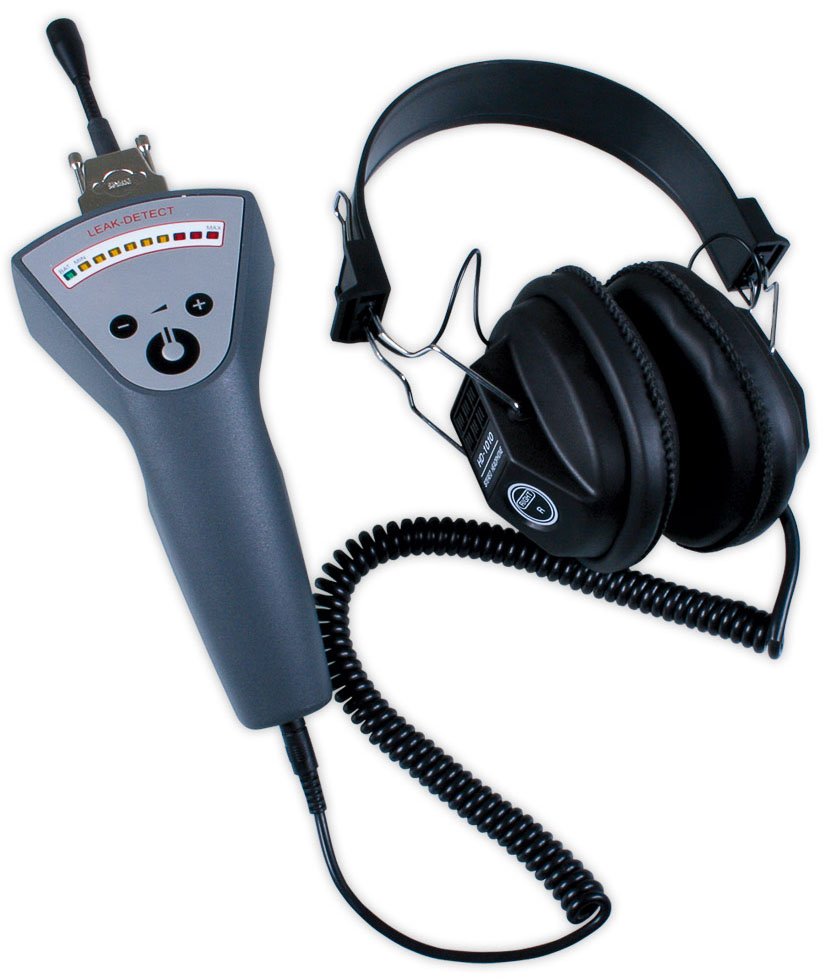
On underground plumbing leaks that pressure testing narrows to a general area but doesn’t pinpoint, acoustic listening equipment can help isolate the exact spot along the line, the same way it’s used on household electronic leak detection. This is typically a follow-up step rather than the first one, used when a leak is confirmed but its precise location under the yard or deck still needs narrowing down.
Does the Pool Need to Be Full and Clear for Testing?
Yes, generally. Dye testing relies on being able to see exactly where the dye is pulled or pushed, so cloudy or algae-affected water makes that much harder to read accurately. Keeping the water reasonably clear and the pool full to its normal level before your appointment helps testing go faster and gives a more reliable result.
Is Draining the Pool Necessary?
Almost never for detection itself. Pressure and dye testing are both designed to work with the pool full, which is part of why they’re the preferred approach over draining. Draining a pool carries its own risks — including shell damage from hydrostatic pressure on some pool types — so it’s typically avoided unless a specific repair actually requires it.
How the Source Is Located Before Any Excavation
Pressure testing first identifies which line, if any, is losing water, which rules out sections that are holding pressure fine. From there, dye testing and, when needed, acoustic listening narrow the leak to a specific point rather than a general area. Only once that location is confirmed does any discussion of opening the deck or accessing a line come up — the goal is always to confirm the exact spot first so that any necessary digging is as limited and targeted as possible.
Pool Leak Detection West Palm Beach vs. Pool Leak Repair
Detection and repair are separate steps. Detection is the process of confirming whether you actually have a leak and pinpointing exactly where it is. Repair — whether that’s resealing a skimmer, patching a shell crack, or replacing a section of plumbing — is separate work that follows once the source is known. Knowing the precise cause first means any repair is targeted at the actual problem instead of a guess. If you are comparing providers, our guide to choosing a leak detection company explains what to ask.
BEFORE YOU CALL
What Can Affect Pool Leak Detection Cost
Beyond the skimmer-versus-underground distinction covered above, cost within that range depends on how many lines need to be pressure tested, whether the leak shows up only under certain conditions (pump on versus off, for example), the size and depth of the pool, and whether a spa, water feature, or multiple suspected areas are involved. As with our other services, the exact number is given after testing rather than guessed up front.
How Long Does a Pool Leak Inspection Take?
A single, accessible skimmer or fitting leak is often confirmed within an hour or two. A suspected underground line, a leak with no obvious source, or a pool with a spa and multiple water features attached can take longer, since each additional line or area adds another round of testing. As always, we’d rather give you an honest range than an unrealistic time estimate.
QUESTIONS
Frequently asked questions
How much pool water loss is normal versus a leak?
Up to roughly a quarter-inch of water loss per day is typically just evaporation, more in peak summer heat. Beyond that consistently, especially if the bucket test shows a gap, it’s worth a real pressure and dye test rather than continuing to top it off.
Can you find a pool leak without draining it?
In most cases, yes. Pressure and dye testing are done with the pool at or near its normal water level, and the pool only needs to be lowered if a suspected leak point sits above the current waterline.
Will fixing a pool leak require breaking the deck or shell?
Not usually. Most leaks are found at skimmers, fittings, or underground plumbing that is reachable without demolition. Structural shell cracks are the exception, and even then the access point is kept as small as possible.
Is a leaking pool covered by homeowners insurance?
It depends on the policy and the cause of the leak. A dated report with test results and photos is provided that can be submitted to an insurer or pool contractor.
Do you service pools outside West Palm Beach proper?
Yes. We serve the surrounding area, including Lake Worth Beach, Royal Palm Beach, Palm Springs and Greenacres and the Intracoastal corridor, in addition to West Palm Beach ZIP codes 33401, 33405 and 33407. If you are searching for pool leak detection near you and are not sure your address is covered, call and ask.
What’s the difference between a skimmer leak and a plumbing leak?
A skimmer leak is localized to where the skimmer body meets the pool shell, usually found with a simple dye test at that spot. A plumbing leak is somewhere in the underground lines connecting the pool to the equipment pad, and typically needs pressure testing to identify which line is affected before it can be narrowed down further.
My spa loses water faster than my pool — is that the same issue?
Not necessarily. A spa attached to a pool often has its own dedicated plumbing and shell, so a spa-specific leak doesn’t always mean the pool itself is affected. Testing typically treats the spa as its own area with its own lines.
Can a pool leak damage the deck or the yard?
It can. A leaking underground line or a crack in the shell slowly saturates the soil around the pool, which can undermine decking, cause settling or cracking near the pool edge, and leave soggy patches in the yard. If you see any of that, mention it when you call, because it helps narrow down where the water is going. Our underground leak detection page explains how buried lines are traced.
Topping off the pool more than it should need?
Call and tell us what you’re seeing, or book by phone, and we’ll test it properly before you spend another dollar guessing.